
Where Yavapai County Warrants Are Issued
Warrants in Yavapai County come from courts. Judges sign them. The Clerk of Superior Court processes the paperwork. The official Clerk duty list names "issues writs and warrants" as one of the core jobs of the office. That single line matters. It tells the public the Clerk is the records keeper for warrants tied to Superior Court matters, and it places the Clerk at the center of any warrant question that involves a felony, a Superior Court civil writ, or a probate-related order. Donna McQuality has held the Clerk's role since 2014.
Justice Courts and Municipal Courts also issue warrants. A Justice Court judge can sign an arrest warrant on a misdemeanor charge filed in that precinct. A Municipal Court judge can sign a bench warrant when a city defendant skips court. The five Yavapai Justice Court precincts cover Prescott, Verde Valley, Mayer, Bagdad, and Seligman. Each precinct has its own clerk's window and its own phone line. The local court that filed the case is the court that controls the warrant.
The Yavapai County Sheriff's Office serves warrants. YCSO does not issue them. Once a warrant is signed and entered, deputies, local police, or other agencies can act on it. The official YCSO headquarters sits at 255 East Gurley Street, Prescott, AZ 86301, with the main phone line at (928) 771-3260. The Yavapai Clerk of Superior Court page describes the Clerk's full duty list, including the writs and warrants function.
Types of Warrants in Yavapai County
A warrant is a court order. Not every warrant is an arrest warrant. Some warrants tell a deputy to bring a person to court. Some tell officers they can enter and search a place. Some hold a person for another state. A few are tied to civil cases, not criminal ones. The label on a warrant matters because it sets the next step. The list below covers the main warrant types that come out of Yavapai County courts.
- Arrest warrant
- A court order that lets law enforcement take a named person into custody. It is signed by a judge based on a finding of probable cause.
- Bench warrant
- Issued by a judge when a person fails to appear, ignores a court order, or is in contempt. It is the most common warrant tied to missed hearings.
- Search warrant
- Authorizes officers to search a place or seize listed items. May stay sealed during an active investigation to protect the case.
- Fugitive or extradition warrant
- Holds a person in local custody for another state or jurisdiction. The hold runs until the outside agency takes the person back.
- Civil writ or warrant
- Used in civil enforcement. May involve garnishment, collection, restitution, or a body attachment for a witness who fails to obey a subpoena.
The Clerk's writs function covers the civil side of that list. The criminal warrants flow through the same Clerk's office for Superior Court matters, but the case file is filed under a CR (criminal) case number rather than a CV (civil) one. Justice Court warrants follow their own case-number pattern set by the local precinct.
How to Check for a Yavapai County Warrant
There is no single search box that returns every active Yavapai warrant. To verify, a person has to work through a few official sources in order. The state Public Access Case Lookup may show warrant status on a known case. The YCSO inmate search shows custody after a booking. The court that issued a case is the final word. The Detention Facility Information Line at (928) 567-7734 connects callers to live detention staff.
- Start with the YCSO Online Yavapai County Inmate Search. If the person is already booked, that confirms custody. The form asks for a last name and shows a data freshness timestamp.
- Open the Arizona Public Access Case Lookup. Search by last name and pick Yavapai County Superior Court or the local Justice Court. Case status may indicate a warrant on file.
- Call the court of jurisdiction during business hours. Justice Courts, Municipal Courts, and the Clerk's office can confirm whether an open warrant ties to a known case number.
- If a person was booked under a John or Jane Doe entry, call (928) 567-7734. Bail cannot be posted on a Doe entry until YCSO Detention completes the fingerprint identification process.
- For sealed warrants or sealed cases, the public portal will not return them. A motion to the issuing court is needed. The Clerk does not provide legal advice on that step.
- Keep all reference numbers and screenshots. A cleared warrant may not update in public systems right away, so a hard copy of the court's confirmation is useful.
The Public Access page updates each Friday and reflects events through the Wednesday of that week. That gap is real. A warrant signed on a Thursday may not show up online until eight or nine days later. The court of jurisdiction is the only source that is live.
Why No Public Active Warrant List Exists for Yavapai County
Some Arizona counties post a public active warrant list. Yavapai does not. Research into the official Clerk, Superior Court, Justice Court, Municipal Court, and YCSO pages did not turn up a countywide active warrant search portal. That gap is the reason this page reads as a verification guide rather than a search tool. A site that fakes a search box for Yavapai warrants is not pulling from a real county feed.
The absence of a public list does not mean warrants are secret. Warrants tied to a known court case can surface through Public Access. Custody confirms the result of a warrant after arrest through the YCSO inmate search. Sealed search warrants stay private by design while an investigation is open, which is consistent with how courts protect criminal investigations across the state.
The bail and release framework is set by A.R.S. § 13-3961. The statute lists which offenses are not bailable as a matter of right and which can be held without bond. The Arizona Legislature posts the current text on its official site. The page tied to that statute is shown in the screenshot below.
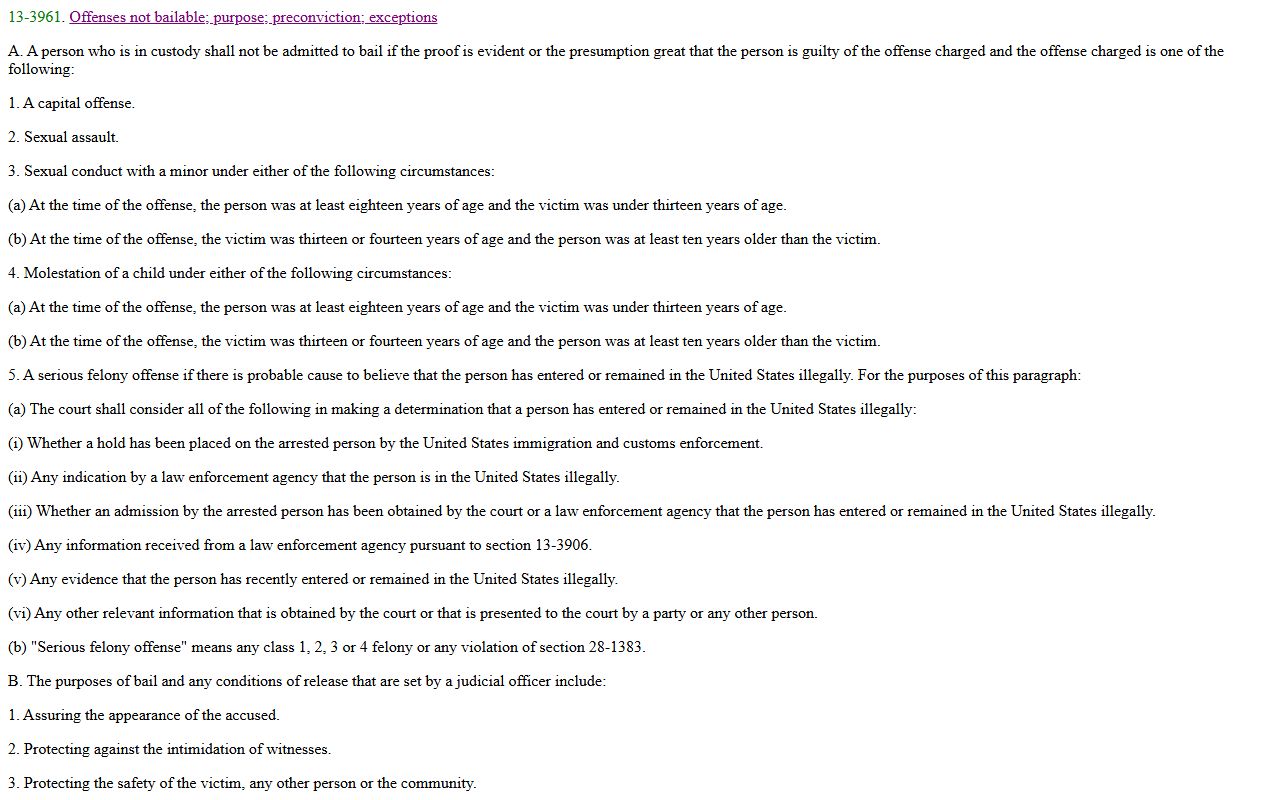
The statute page lays out the categories that affect whether a warrant suspect can be released on bond after an arrest. It is the source of truth, not a third-party summary.
Bench Warrants and Failure to Appear
A bench warrant is the most common warrant a Yavapai resident may run into. It is signed from the bench, in open court, when a defendant skips a hearing, misses a payment plan deadline, or ignores a court order. The judge does not need new probable cause for a fresh crime. Failure to appear on the existing case is enough.
Bench warrants can stack. A missed status hearing, a missed pretrial conference, and a missed sentencing can each generate its own warrant. Each warrant may carry its own bond. That is why the issuing court is the source to call. Only the court that signed the warrant can quash it, recall it, or set a new appearance.
In Yavapai, Early Disposition Court at the Yavapai County Justice Center handles many early criminal calendars. A defendant on EDC who misses the morning calendar can end the day with a bench warrant. The fastest fix is usually a same-day or next-day appearance with counsel, not a phone call to a stranger.
Posting Bond in Yavapai County
If a Yavapai warrant carries a bond amount, that bond can be posted through three official routes. The Prescott Detention Center at 1200 Prescott Lakes Parkway and the Camp Verde Detention Center at 2830 N Commonwealth Drive, Suite 105 both accept bond in person 24 hours a day. The court of jurisdiction also accepts bond during business hours.
The third route is GovPay. Yavapai's official Pay Location Code is A001YN. To post bond through GovPay, the payer needs the payment amount and the arrestee or defendant's name. Phone payments run through 1-877-EZBAIL5, which is also 1-877-392-2455. A receipt confirms the payment. A copy of that receipt should be kept and shared with the court of jurisdiction.
Meals in YCSO custody carry a daily $2.00 charge under A.R.S. § 31-121. That subsistence fee is not a bond. It is a separate jail charge and applies during the time a person is held. The screenshot below is the official statute page on the Arizona Legislature site.
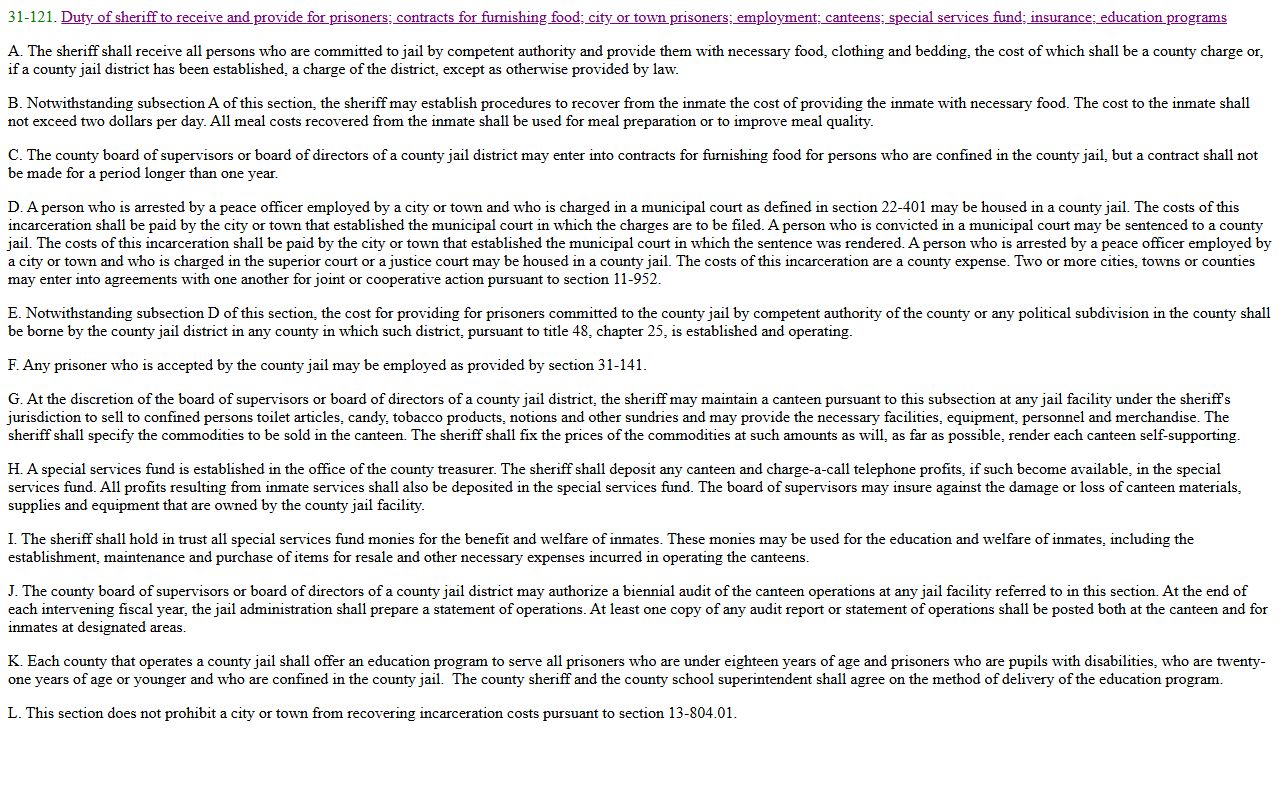
The statute is the source for the $2.00 meal charge YCSO cites on its intake page. Knowing the difference between bond, jail fees, and court costs helps a person avoid paying the wrong number to the wrong place.
YCSO Scam Warning
Warrant scams target Yavapai families. The caller may claim to be a deputy, a court officer, or a bondsman. The caller may pressure the victim to send gift cards, wire money, or buy prepaid debit cards "to clear a warrant" or "to release an inmate." That is not how the process works. The Sheriff's Office issued a fresh warning on October 15, 2025.
Important: The Yavapai County Sheriff's Office never calls, emails, or texts to request or collect money for inmate programs, fines, warrants, or release conditions. Treat any such contact as a scam. Hang up. Do not send funds. Report the contact to YCSO at (928) 771-3260 and to local law enforcement.
Real warrant resolution happens at a courthouse, a jail, or through GovPay using the published PLC A001YN code. It does not happen through a stranger on a phone who demands payment in the next ten minutes. A scammer may know a real case number, a real address, or a real charge. None of that proves the call is real.
If a caller pushes a deadline, that is the strongest tell. Courts give notice in writing. Bondsmen do not need gift cards. The Clerk's office does not collect fines by phone using anonymous payment methods. The YCSO scam alert is plain on this point.
Clearing a Warrant Through the Court
A warrant clears one of three ways. The person appears in court and the judge recalls the warrant. The person turns themselves in at a jail and the court schedules the next appearance. The case is resolved by plea, dismissal, or sentence and the warrant becomes moot. Each path runs through the issuing court.
To set the appearance, the safest first call is to the court of jurisdiction. For Superior Court matters, the Clerk's Records line is (928) 777-7934. The Clerk's office sits at 120 South Cortez Street, Prescott. For Justice Court warrants, call the precinct that filed the case. For Municipal Court warrants, call the city court for the city that filed the charge.
An attorney can file a motion to quash. A motion to quash asks the judge to lift the warrant without an arrest, often paired with a new court date. The Yavapai Clerk's main page lists the records, marriage, jury, and fines/fees contacts. The YCSO Intake and Release page explains how a person should plan for a court-ordered or self-surrender custody.
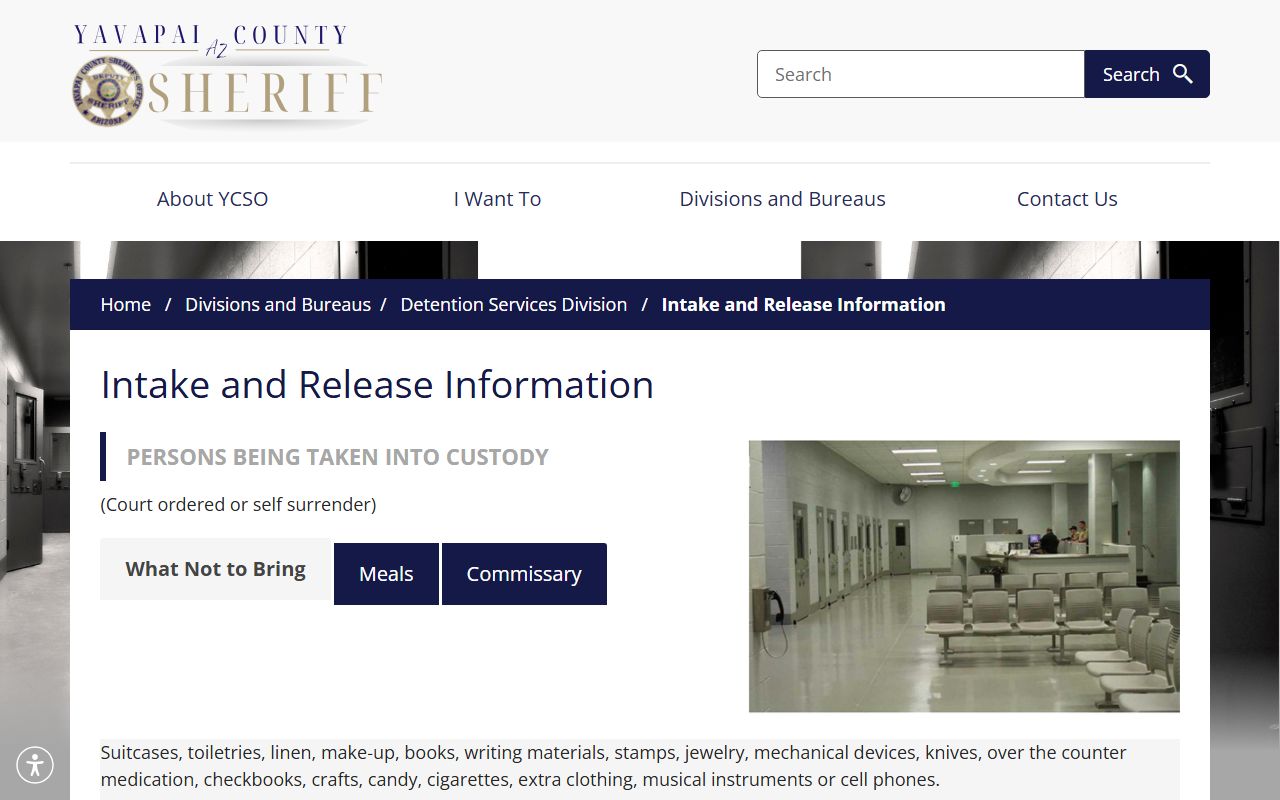
The page covers what not to bring to intake, the daily meal fee, commissary, hygiene, and release medication steps. It is the official YCSO source for what happens after a person turns themselves in or is brought in on a warrant.
What Yavapai County Warrant Records Show
Because no public active warrant portal was located for Yavapai County during research, a live sample warrant printout was not captured. The fields below are general categories that warrant records may contain across courts in Arizona. The exact fields shown on any single Yavapai warrant depend on the issuing court, the case type, and whether the warrant is sealed.
For a known case, Public Access Case Lookup may surface the case number, party name, charge code, and case status. eAccess may surface document images for covered Superior Court files. Sealed cases will not appear. Juvenile cases follow separate rules under A.R.S. § 8-208.
| Field | What It Generally Shows |
|---|---|
| Case number | The court's case ID. May start with CR for criminal or CV for civil. |
| Defendant name | The party named on the warrant. Includes any known alias if a court has noted one. |
| Issuing court | Yavapai County Superior Court, a Justice Court precinct, or a Municipal Court. |
| Warrant type | Arrest, bench, search, fugitive, or civil. Sealed search warrants stay private. |
| Bond amount | The bond set by the judge, if any. Some warrants are no-bond per A.R.S. § 13-3961. |
| Case status | The current docket position. Public Access updates weekly. |
A warrant printout from the issuing court will carry more detail than a public portal. The court's own copy is the controlling document. A person who needs the actual warrant text should request it through the Clerk of Superior Court if the warrant is tied to a Superior Court case, or through the Justice or Municipal Court that filed the original case.
For broader background on the criminal track that may run alongside a warrant, the Yavapai County criminal records page covers arrests, charges, and dispositions. For the custody side after a booking, the inmate records page covers the YCSO inmate search and detention process. The court records page covers Public Access and eAccess. Common questions sit on the FAQ page.