
Yavapai County Probate Court in Superior Court
Yavapai County does not run a stand-alone probate court. Probate is heard inside Superior Court. The Clerk of Superior Court is the registrar of probate matters. Donna McQuality serves as the elected Clerk. Her office keeps the file for each probate case from opening through close. Most paper requests start at the Clerk's main counter in Prescott at 120 South Cortez Street, Room 207. Verde Valley filers can use the Camp Verde courthouse at 2840 North Commonwealth Drive.
Probate sits next to civil, family, criminal, and juvenile work on the Superior Court docket. Judges and commissioners assigned to probate hear hearings on appointment of personal representatives, contested wills, accountings, and protective orders for adults. Guardianship and conservatorship cases also pass through this same probate track. The Clerk's role is record keeper, not judge. Legal advice has to come from a lawyer. The Self-Service Center holds blank forms but cannot help fill them out for a specific case.
Probate filings in Yavapai County feed the same case index used for other court records. A probate case shows up in Public Access under the Yavapai County Superior Court name. The PB case prefix marks probate matters. Sealed probate items, redacted protected-person details, and confidential medical exhibits do not appear in the public view.
The official source for probate registrar duties is the Yavapai County Clerk of Superior Court page. That page lists Clerk leadership, statutory duties, and the records request routes also used by the Clerk of Court page on this site.
Types of Probate Cases Handled in Yavapai County
Probate is broader than just wills. Yavapai Superior Court hears the full range of estate and protective matters. Some cases run informal and need almost no court contact. Other cases run formal with notice, hearings, and orders. Small estates may skip the case path through the affidavit route.
- Decedent estates covering assets, debts, and distribution to heirs or devisees.
- Will admission for testate matters where the decedent left a valid will.
- Informal probate with limited court oversight for uncontested estates.
- Formal probate for contested wills, missing wills, or disputed heirs.
- Small estate affidavits under A.R.S. § 14-3971 for qualifying personal property and real property.
- Guardianship of a minor or incapacitated adult.
- Conservatorship over the finances of a protected person.
- Trust proceedings tied to estate administration and trust disputes.
Each track has its own forms in the Self-Service Center library. The Probate and Guardianship category bundles most templates. An Additional Forms section covers items that do not fit the main packets. Self-represented filers should pull the matching packet, read it in full, and pay close attention to notice and inventory steps.
Probate Specialist Contacts
Two Probate Specialist desks serve the public. One sits with the Clerk in Prescott. The other works the Camp Verde courthouse. Both desks handle case questions, scheduling notes, and file lookups for probate, guardianship, and conservatorship cases. They do not give legal advice. They do not draft documents. They can route a question to the right division or set up an in-person file review.
Prescott Probate Specialist
Yavapai County Clerk of Superior Court
120 South Cortez Street, Room 207
Prescott, AZ 86303
(928) 777-7949
Mon-Fri 8:00 a.m. - 5:00 p.m.
Verde Probate Specialist
Yavapai County Superior Court
2840 North Commonwealth Drive
Camp Verde, AZ 86322
(928) 554-8536
Mon-Fri 8:00 a.m. - 5:00 p.m.
Calls about open probate cases should include a case number when known. The PB prefix and the year filed help the desk find the file fast. If a case predates 1992, the records request should be routed to the Prescott courthouse records team because older files may not be in the current case index.
Small Estate Affidavits Under A.R.S. § 14-3971
Not every estate needs a full probate case. Arizona allows a small-estate path through an affidavit. The rule is set out in A.R.S. § 14-3971. Heirs who qualify can collect personal property or transfer real property under set dollar limits without opening a court case. The affidavit goes to the holder of the asset or, for real property, is filed with the county recorder after the waiting period.
The Arizona Legislature page below shows the statute text used to confirm small estate limits, waiting periods, and required statements. Visit A.R.S. § 14-3971 on azleg.gov for the controlling text.
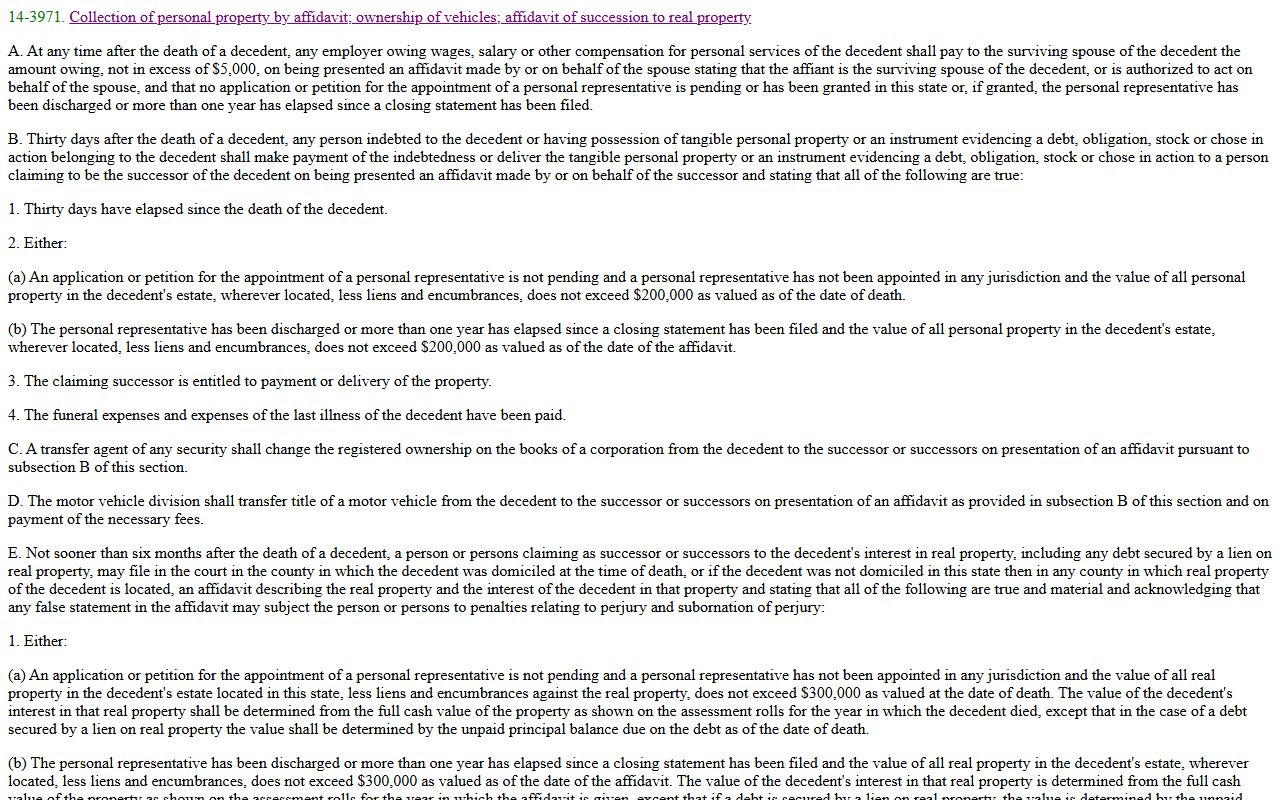
The statute caps each path at a fixed dollar amount and sets a wait of at least 30 days after death for personal property and at least six months for real property. The affidavit must include sworn statements about the death, the assets, and the heirs.
Self-represented users can pull blank small estate affidavit forms from the Self-Service Center. Forms are not legal advice. The court warns self-represented persons that they must know and follow proper procedures like attorneys. When in doubt, talk to a probate lawyer. A bad affidavit can leave debts unresolved or expose the heir to claims later.
Searching Yavapai County Probate Records
Public probate cases are searched on the same statewide tools used for other Yavapai cases. The Arizona Public Access Case Lookup shows the case index and the docket. Document images are only on Arizona eAccess when the court and the document type are within coverage. Sealed and confidential probate items do not appear.
Start with the decedent's full last name. Add a first name. Set the date filter to a year range that covers the death and a few years after, since estates can be opened later. Pick Yavapai County Superior Court in the court dropdown. The PB prefix marks probate cases. Open the case row to view the docket and parties.
For copies, certified copies, or any file that does not appear in eAccess, contact the Clerk. Email requests go to YavapaiRecordsManagement@courts.az.gov. The records phone is (928) 777-7934. The Clerk replies with a total quote before payment runs through the online payment center. The general court records page covers Public Access and eAccess in more detail.
The Self-Service Center page below is the main county pro se hub. It holds Probate and Guardianship forms, fee deferral packets, and instructions for filers without a lawyer. The source page is Yavapai County Self-Service Center.
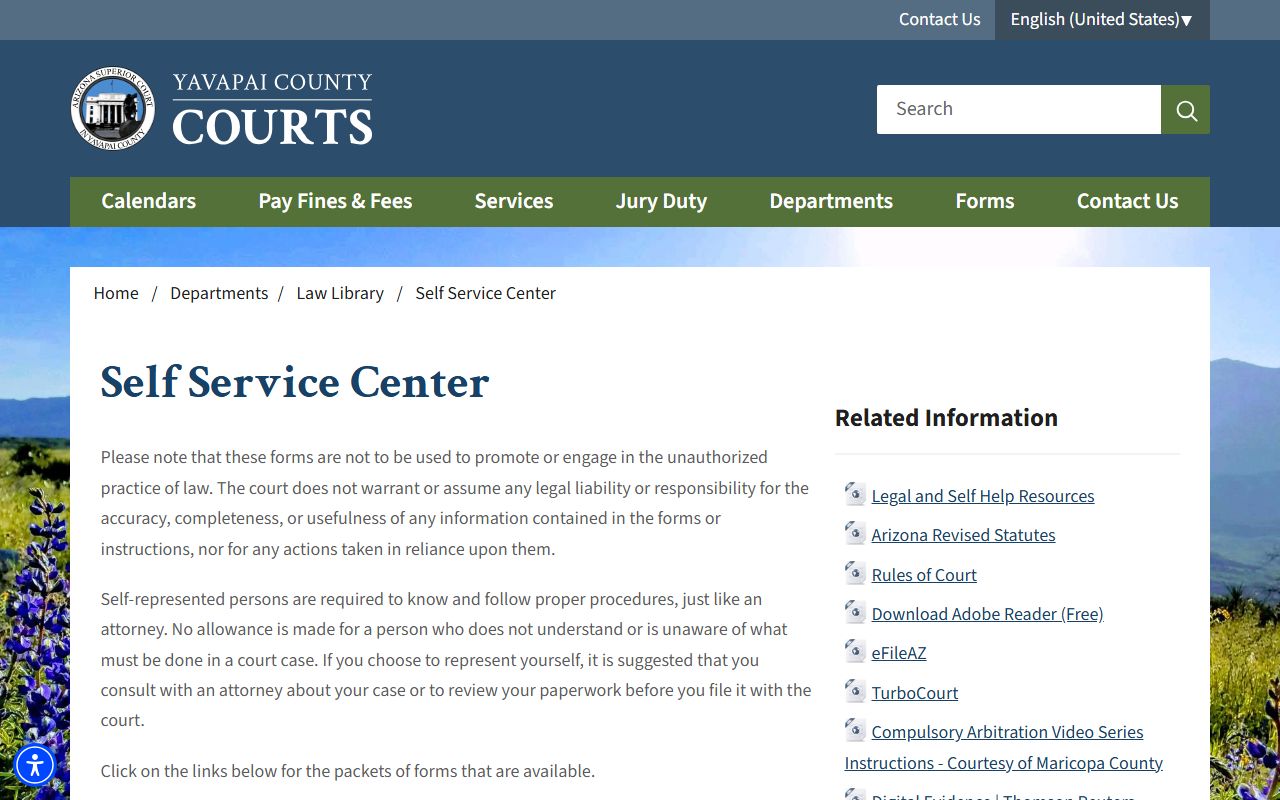
The forms library groups probate templates by case type. Probate and Guardianship sits next to civil, domestic, juvenile, adoption, and criminal forms. Use the Additional Forms section for items not in the main packets.
How Probate Works in Yavapai County
The basic flow runs from opening to closing. Most estates follow the same path, with side trips for contests or accountings. Conciliation Court Services, shown below, is a separate family-law service, but it sits in the same Superior Court footprint that runs probate. The page is at Yavapai County Conciliation Court Services.
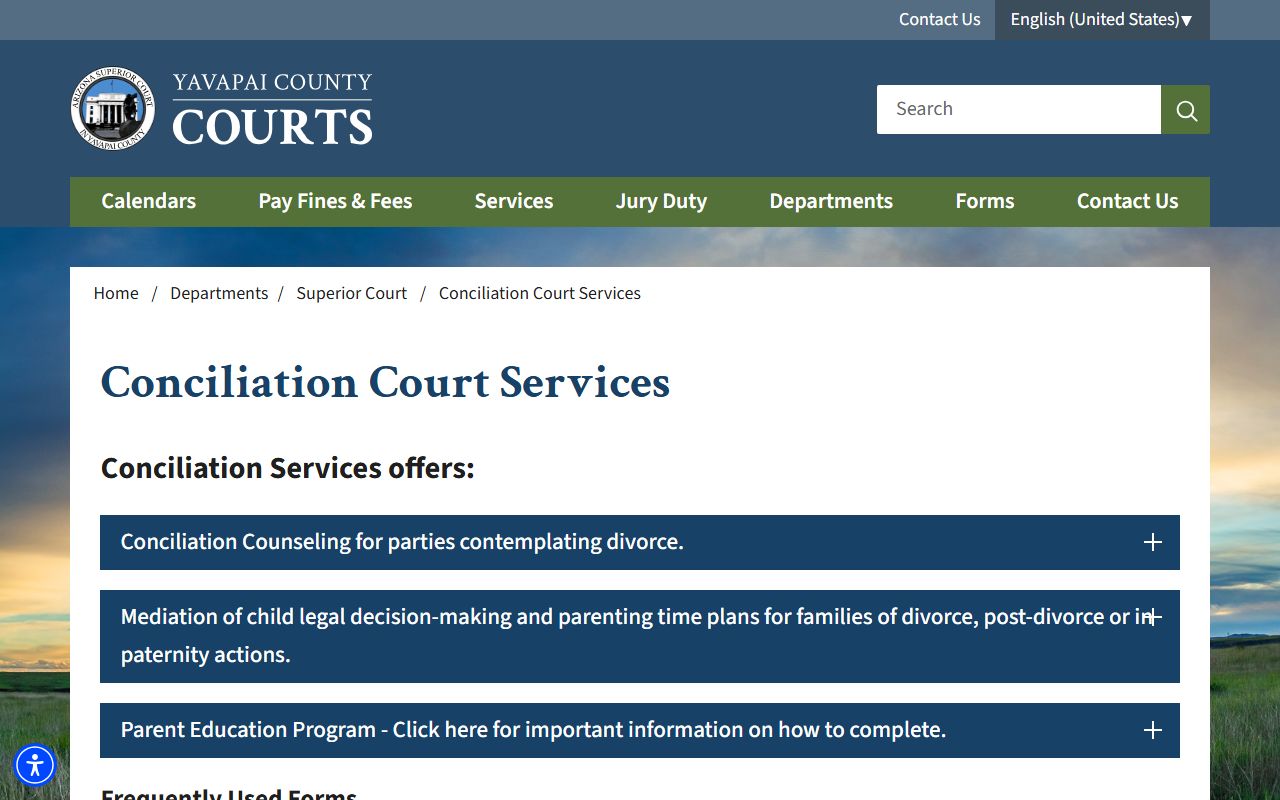
The Superior Court services page links the broader court divisions that surround the probate desk, from conciliation to civil intake.
- Confirm whether full probate is needed or whether a small estate affidavit under § 14-3971 applies.
- Pull the matching Self-Service Center forms or hire counsel.
- File the case in the correct Superior Court location, Prescott or Camp Verde.
- Pay filing fees or apply for a fee deferral or waiver using the Self-Service packet.
- Serve and notify all interested persons under the rules and order of court.
- Attend any hearings on appointment, will contests, or protective orders.
- File the inventory, accountings, and closing statement on the schedule the court sets.
- Request certified copies from the Clerk for banks, the recorder, or other agencies that need them.
Self-represented persons must follow the same procedures as attorneys. The court does not relax filing rules for pro se litigants. Missed deadlines, bad service, or a faulty inventory can stall a case or lead to dismissal.
Probate Filing and Copy Fees
Copy fees are set by statute. The Clerk follows A.R.S. § 12-284 for fee authority. Plain copies are billed by the page. Certified copies add a flat charge plus the page rate. Mailed copies need a self-addressed stamped envelope or $8 in postage. The fee schedule below covers the most common probate copy costs.
| Item | Amount |
|---|---|
| Plain copy per page | $0.50 |
| Certified copy with raised seal | $35.00 + $0.50/page |
| Postage and handling (no SASE) | $8.00 |
| Small estate affidavit form packet | Free download from Self-Service Center |
Probate filing fees themselves are set by Superior Court and the state fee schedule. The official Yavapai Superior Court probate filing-fee schedule was not extracted into the source research used for this page. Confirm current filing-fee amounts with the Clerk before filing. Call (928) 771-3312 in Prescott or (928) 567-7741 in Camp Verde. Fee deferral and fee waiver packets are available at the Self-Service Center for filers who cannot pay up front.
Email requests run through a quote step. Send a request to YavapaiRecordsManagement@courts.az.gov, wait for the total, then pay through the Clerk online payment center. Pre-1992 probate files should be routed through the Prescott courthouse records team.
Restricted Probate Information
Probate records are court records. Most are open to the public. Guardianship and conservatorship cases are different. These files often include medical reports, financial accountings, and protected-person details that are redacted or restricted under court rules and Arizona statutes.
Behavioral health records are shielded by A.R.S. § 36-509. Social Security numbers, account numbers, and minor identifiers are removed from the public view in line with court rules. Sealed probate items, like a sealed inventory or a sealed medical exhibit, do not show in Public Access or eAccess. The public records page covers the broader Arizona inspection rule.
A person who wants a sealed probate record viewed must file a motion in the same court. A judge decides whether the record opens. Routine probate filings, like the petition, will, inventory, and final accounting, generally stay open absent a separate order.
Probate Terms
Probate uses a set of legal terms that confuse first-time filers. The definitions below match the way Arizona uses each term. They are not legal advice. For a specific case, talk to counsel or check the matching Self-Service Center packet.
- Testator
- The person who makes a valid will.
- Executor
- The person named in a will to manage the estate.
- Personal Representative
- The court-appointed administrator of an estate. Arizona uses this title for both will-based and intestate cases.
- Intestate
- A case in which the decedent died without a valid will.
- Guardian
- A person appointed to make personal decisions for a minor or an incapacitated adult.
- Conservator
- A person appointed to handle the financial affairs of a protected person.
- Fiduciary
- A person, including a personal representative, guardian, or conservator, who holds legal duty to act in another person's best interest.
For related family-law records, see the marriage and divorce page. For general filing access, see the court records page. Common questions on copies and access also appear in the FAQ page.